
What Is COBRA Coverage?
- COBRA stands for the Consolidated Omnibus Budget Reconciliation Act. It lets qualified workers keep their group health insurance for a limited period after losing coverage because of a qualifying life event.
- The law applies to most private-sector businesses with 20 or more employees.
- Since COBRA participants count as covered lives under a self-insured health plan, plan sponsors are responsible for paying the PCORI fee on their behalf.
Who Is Eligible for COBRA Coverage?
Terminated or Reduced-Hours Employees
Workers whose jobs end or whose hours fall below the plan threshold can elect COBRA for up to 18 months. For every month they stay enrolled, they count toward your covered lives calculation.
Spouses and Former Spouses
After events like divorce or legal separation, a covered employee's spouse or former spouse becomes eligible. Their enrollment period counts toward your average covered lives when you go to file the PCORI fee for COBRA coverage.
Dependent Children
Dependents who lose plan coverage, like those who age out, are qualified COBRA beneficiaries. Each dependent gets counted as its own covered life, not grouped together with the employee on the same line.
Surviving Family Members
When a covered employee passes away, the surviving spouse and dependents become eligible for COBRA for up to 36 months. Plan sponsors stay on the hook for the PCORI fee for COBRA coverage for every month of that window, not just the first year.
Common Challenges in PCORI Filing for COBRA Plans

Manual Data Collection for Covered Lives
COBRA participants come and go throughout the year, which makes getting accurate numbers a real headache come filing time. You end up pulling records from HR systems, TPA reports, and carrier files, often by hand, hoping everything lines up before the July deadline. That kind of process leaves a lot of room for someone to fall through the cracks, and you end up filing with a number that's off.

Complex Covered-Life Method Selection
For self-insured plans, the IRS allows three calculation methods: Actual Count, Snapshot, and Form 5500. Using the wrong one, or applying it differently to your COBRA group than to your active employee population, can mean you're underpaying or overpaying. An overpayment isn't just wasteful since it also requires filing a Form 720-X amendment to correct it.

Higher Risk of Form Entry Errors on Form 720
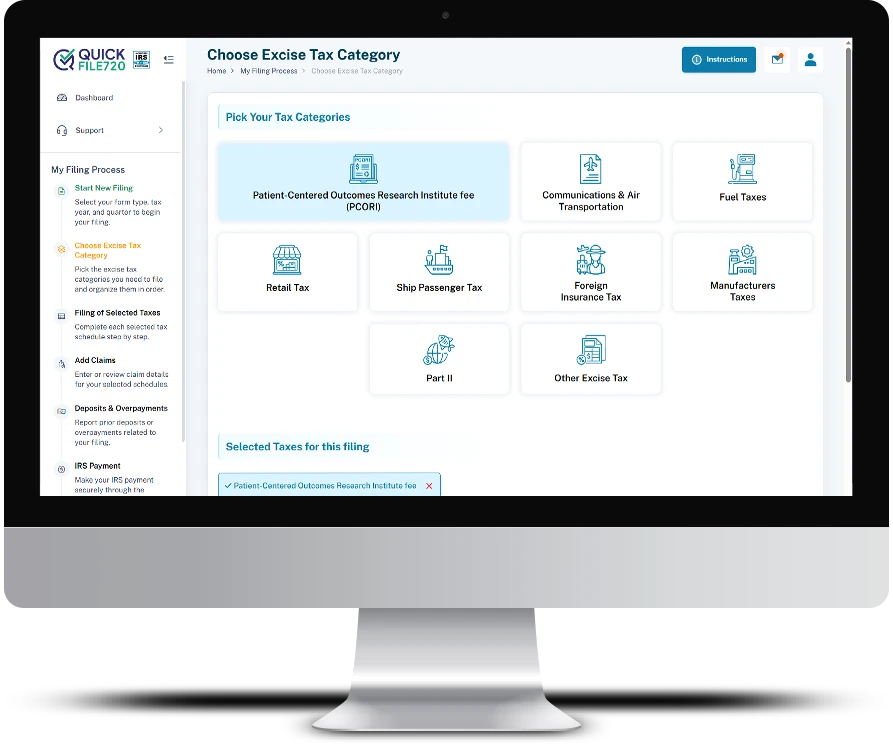
The PCORI fee for COBRA coverage goes on Form 720 under IRS Number 133. Paper forms don't do any math for you, so one wrong number in the covered-lives field throws off the total. There's no built-in check until the IRS catches it on their end.

Paper-Based Record Management
Keeping calculation worksheets, enrollment reports, and payment confirmations organized in a paper-based system gets messy fast. Things get misplaced, folders get buried, and when the IRS wants documentation, pulling it together quickly turns into its own project.

Payment Coordination and Proof Tracking
With manual filing, you still have to verify that the payment went through correctly and that it got matched to the right return. Storing that proof somewhere you can actually find it later takes time and attention that most plan administrators would rather spend elsewhere
Why File the PCORI Fee for COBRA Coverage Plans Online?
Faster Than Paper, With IRS Confirmation
Online filing sends your Form 720 through an IRS-authorized portal, and acknowledgment usually comes back within minutes. No waiting on mail, no wondering if the envelope arrived, no backlog delays
Auto-Calculated Fees
Put in your average covered lives and the portal does the math. For plan years that ended between October 1, 2025 and October 1, 2026, the rate is $3.84 per covered life, applied automatically before you review and submit. Try our PCORI Fee Calculator Online.
Easier Audit Records
Every submission creates a digital confirmation that has your filing details. Much faster to retrieve than a paper copy, and a lot easier to hand over if the IRS ever comes asking.
Why File PCORI Fee for COBRA Coverage Plans With QuickFile720
IRS-Authorized Portal
QuickFile720 is authorized by the IRS for Form 720 e-filing, Your COBRA PCORI fee submission goes through an approved channel, and IRS acknowledgment comes back in minutes, not weeks.
AICPA SOC Certified Portal
QuickFile720 holds AICPA SOC certification, so your enrollment data, EIN, and payment details are handled under tested security controls. Nothing sensitive goes through an uncertified system.
Simple and Affordable Solution
Five steps from login to submission. No software installs, no paper forms. Flat pricing works for CPAs, TPAs, and employers of all sizes, and it costs less than managing the whole thing manually.
Bulk Filings
QuickFile720 offers a unique feature which enables you to file multiple plans simultaneously. You will just need to download the template, input all the information about your plans, and upload the document again, and your multiple plans will be processed in just a few minutes.
Testimonials
No More Chasing Numbers Before July
We have active employees and COBRA participants on the same plan. Every July used to mean pulling reports from three different sources and hoping the counts matched. With QuickFile720, we enter the covered lives, the fee is calculated automatically, and the IRS confirmation hits our inbox the same day.
The Right Tool for Multi-Client PCORI Filing
I handle PCORI filings for several employer clients each July, and a few of them have COBRA populations that shift every quarter. QuickFile720 keeps each client organized, applies the right rate without me double-checking the IRS table, and gives me a confirmation record I can drop straight into the client file.
Done in Under Ten Minutes
We had two consecutive years where our paper Form 720 got delayed. Switched to QuickFile720 and filed the PCORI fee for COBRA coverage in one sitting. Selected IRS Number 133, entered the covered lives, reviewed the number, and submitted. IRS approval came back fast.
File Your PCORI Fee for COBRA Coverage Before July 31
The deadline doesn't move. QuickFile720 handles the calculation, the Form 720 filing, and the IRS submission in a few steps, with no paper and no guesswork.
Create Your Free Account and File your PCORI Fee online with QuickFile720
File Online Now